19 movies in. 5 movies per day. Not nearly enough sleep. The movies are finally starting to bleed together.
It’s happening in a good way. In a cool way. In a social experiment sort of way. Characters from one movie are confused with another. Ideas that are set up in the 10:00 film are paying off in the 5:00 film. Locations are starting to blur. It’s all turning into one big mushy ball of organic matter. But fun nonetheless.
Examples:
- in Zift, a film title which literally translates to shit, I find myself thinking that there a few too many poop and fart jokes. The best of them is when a character visits London where there is literally dog crap on the sidewalk everywhere he goes. Then I remember: that bit wasn’t in Zift at all. It was an old gag referenced with respect to an Aussie Ocker comedy in Not Quite Hollywood.
- Zift again. I get a sense that our female protagonist will betray and devour the hero and recall some foreshadowing to that effect. Suddenly I can’t remember if said foreshadowing was in this film or not (turns out it was.)
- in Brothers Bloom, it becomes apparent that one of the principle themes of the movie is storytelling, which helps to explain all the random side-bar anecdotes that pepper the first half of the movie. Except the tangents I’m thinking of happened in Zift.
- Evangeline Lilly sits in front of me at the premiere screening of The Wrestler and then turns in a bit part in Kathryn Bigelow’s Hurt Locker. For a moment I’m confused. Was Mickey Rourke fighting in Iraq?
I’m dead serious about all this. These are the sort of sharp angles that my brain has been cutting in the last two days. And so it goes.
May the movie gods help me when actors begin to cross over from movie to movie (due to begin happening shortly).
Wednesday, September 10, 2008


Tuesday, September 09, 2008
Tuesday (TIFF Day 6)
A late start today (my first film was at 2:30) but still able to squeeze in five flicks. Today also marks the first day that I've overstretched myself by timing movies just a little too close together. I've had to run-subway-run to two movies this afternoon, making the trip from Dundas to the Varsity in less than 15 minutes. Not recommended. In the future, I'll need to remember that every movie ends 15-20 minutes later than scheduled.
 Presented to some degree by Quentin Tarantino, Not Quite Hollywood follows the rise of Australian genre cinema of the 70's and 80's (or what the film calls "Oz-ploitation"). The film is astonishingly fun, tackling every aspect of Aussie cinema from wild sex comedies (ockers) to full-on gore and creature features to adrenalin-filled road movies (including Mad Max). Acting like a greatest hits tape, the film puts some of the scenes in context with interviews from the filmmakers. The background stories (particularly those involving Dennis Hopper) are almost as batshit-crazy as the up-front features.
The film also provides, almost by accident, a lunatic tour of Tarantino's influences (and to some degree the cinema-savant mapping of his brain). Tarantino isn't shy to point out the innovative Aussie scenes that he has co-opted or outright stolen through the years. Included is a great story about lifting elements of cult-hit Patrick for Uma's Kill Bill coma scenes.
This an amazing doc and a true love letter to a sort of drive-in cinema that most of us will never get to enjoy in a proper context. I can't wait to see it again just so I take better notes of titles and performers. There's a magnificent marathon to be found in the borders of this doc.

At any rate...
Not Quite Hollywood ~ Not Quite Hollywood is a frustrating film for anyone who loves movies. Frustrating not because it isn't excellent and insightful (it is!) but because the film talks in detail about a lot of exciting films that we will probably never see in Canada. At the very least, it creates a whole new shopping list of treasure-hunt DVD titles. Collectors and completists will lose their minds. (I've already started the hunt for Turkey Shoot, Man from Hong Kong and the delicious Razorback. Road Games, which I own, and the recently released Rogue have also jumped to the top of the queue).
Presented to some degree by Quentin Tarantino, Not Quite Hollywood follows the rise of Australian genre cinema of the 70's and 80's (or what the film calls "Oz-ploitation"). The film is astonishingly fun, tackling every aspect of Aussie cinema from wild sex comedies (ockers) to full-on gore and creature features to adrenalin-filled road movies (including Mad Max). Acting like a greatest hits tape, the film puts some of the scenes in context with interviews from the filmmakers. The background stories (particularly those involving Dennis Hopper) are almost as batshit-crazy as the up-front features.The film also provides, almost by accident, a lunatic tour of Tarantino's influences (and to some degree the cinema-savant mapping of his brain). Tarantino isn't shy to point out the innovative Aussie scenes that he has co-opted or outright stolen through the years. Included is a great story about lifting elements of cult-hit Patrick for Uma's Kill Bill coma scenes.
This an amazing doc and a true love letter to a sort of drive-in cinema that most of us will never get to enjoy in a proper context. I can't wait to see it again just so I take better notes of titles and performers. There's a magnificent marathon to be found in the borders of this doc.
***
Pontypool ~ A Canadian zombie film? How could you not?
I went into this cautiously, recognizing that Bruce McDonald would not be delivering a Romero experience. In fact, the reputation was that the premise was sort of artful: the zombie virus is transmitted by language (!) There are no zombies to be "seen" in this movie. And in most respects, it's not really a zombie film at all since the afflicted are either slaughtered or still alive (as far as I could tell there was no un-dead!) Cautious or not, the final product is spectacular.
Here's one of those films that you watch without breathing - not because the tension is high, although it is - but because you are watching a film that is so delicately set up in the first two acts that you begin to worry that it won't find the right way to finish. The good news is McDonald sticks the landing (though it's worth pointing out that it's that final third that deviates the most from the traditional zombie set-up, by digging deep into the clever and sophisticated linguistics-as-virus material).
So it works in two ways: it's a smart film about communication and media, and it's also a finely-tuned horror film, watching the end-of-the-world from the perspective of a small-town radio station. And McDonald knows his horror: the decision to show us nothing outside of the basement radio station is one of the smartest. After years of zombie films, we can imagine as much or as little as we'd like. And we're trapped with the characters throughout, thinking the worst but able to confirm nothing.
Special mention should also be made to Stephen McHattie (or Canada's answer to Lance Henrickson). I could watch this guy in anything.
***
Zift ~ An atmospheric first film that could have been much much more, but nevertheless delivers the promise of some greater things to come. Lifting directly from Hollywood film noir and some classic heist films (Rififi came to my mind more than once), Zift is an imaginative crime film that is more remarkable for its visuals than its plotting.
Here is a film that introduces principle characters with names like The Mole, The Mantis, The Sloth, The Skin and The Eye. Everyone is similarly sketched with tattoos as if you couldn't keep their names straight. The plot is equally inventive,  setting up the Mole's release from prison even as it flashes back to the heist (and relationship) that put him there. While every scene is dazzling in its own way, there is not enough overall sizzle to keep the plot warm throughout and Zift gets off-topic on a number of occasions. To be a classic, a movie like this needs to be constructed like a laser, but Zift trips up in colourful digressions that seem more suited to a Paul Thomas Anderson film than a crime film of this sort.
It should also be noted that this a Bulgarian film that deals with some pretty particular 1940's and 50's politics. As a result, I got a sense that there were dimensions and nuances to the story that were floating over my head. I wonder what Bulgarians made of this story.
[You can check out the visual dazzle (and the principle reason I added this film to the line-up) of the trailer here.]
***
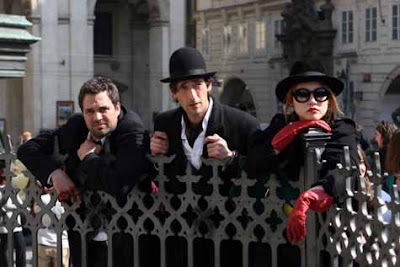
The Brothers Bloom ~ Showing the same visual wow and smart-kid plotting as Brick, Rian Johnson improves on his sophomore effort by adding two new colours to the mix: light comedy and sugary sweetness. Brothers Bloom, as if it weren't obvious, is the story of two brothers, and some of the best scenes come early as we see the gentle interplay between them. There's affection and protection happening between them (particularly for older brother Ruffalo who seems to set up his con largely to let young brother Brody play out his unspoken desires). And in that first half, everything is firing perfectly. For a spell, Brothers Bloom feels like one of the most effortless and endearing movie-movies in a long time as Johnson uses all his virtuoso tricks to set up the characters, backstories and con-game in short visual strokes.
But in the second half, the storm clouds roll in. Once the con is in play, the film sags under the weight of it, losing focus (and lightness) in the very parts where the pieces should be coming together. The performances are still very good (Brody and Weiss seem to have the most fun) but the playful qualities and visual inventiveness all but disappear. In short, Bloom settles down to be just another movie (something it is NOT in the first half).
Still, the film is by no means a complete disappointment, even if the final package doesn't hang together as completely as Brick. Johnson is still clearly a blossoming master with a voice and personality that it unique among scores of other new directors. I'll just as eagerly be lining up to see his next genius project.
***
The Burrowers ~ Described as a Western Horror in the TIFF program (a sort of Searchers-meets-The Descent experiment), The Burrowers was pretty much nothing more and nothing less than promised. The short version is that a hunting party on the trail of some kidnapped settlers uncovers a group of subterranean creatures (whom they initially mistake for natives). Director J.T. Petty takes his sweet time finally introducing the creatures (which is tough for a midnight sit) but ultimately delivers a goodly amount of eaten-alive horror.
Still, as you might guess from the mash-up premise, apart from mix genre trappings, there is hardly a new element to be found in this film. And when your film makes Tremors feel a bit like a trailblazer, there might be a problem. Worse, after hanging the audience on expectation for most of the first half of the film, the second half (and particularly the ending) doesn't really deliver a climax satisfying enough for the clever premise. Big problem for a movie that finishes screening at 2:00 am.
Monday, September 08, 2008
Monday (TIFF Day 5)
A home day. Call it rest or call it quality time with the kids, because it's both. No movies today.
I'm back at it tomorrow with a 5-pack that will begin to wander into the Midnight Madness line-up. As a result, I'll be getting home very, very late in the nights to come and may be slow to post for a spell.
I'm back at it tomorrow with a 5-pack that will begin to wander into the Midnight Madness line-up. As a result, I'll be getting home very, very late in the nights to come and may be slow to post for a spell.
Sunday (TIFF Day 4)
Fauborg 36 ~ In a sub-genre that I’ve just this moment created, of films about eccentric theatre groups putting on The Big Show to Save the Theatre, Fauborg 36 ranks very very well. In fact, for a spell, the movie teases with Busby Berkley madness by sticking all of the plot mechanics up front then creating a dizzy musical montage in the third act that (almost) breaks the fourth wall. The Berkley posture is broken only by the fact that Fauborg 36 doesn’t seem to have nearly enough musical numbers and instead, dresses its final act with a touch of French tragedy.
If it’s not already dead obvious, this is a downer of a movie redeemed only because we are afforded a real sense that this is only one chapter in a much larger story. There are no references to the chapters that came before and lord knows, the story to follow could still have a very happy ending. As far as it goes, this is a small gem that won’t be for everyone.
(I switched this out for Ghost Town, which I didn’t need or even really want to see.)
***
Waltz With Bashir ~ At equal turns gorgeous and horrible, Waltz With Bashir works on so many levels that I don’t want to say much until I’ve had the chance to see it again. The quasi-animated universe of the film is stunning and innovative, providing a surreal backdrop to what amounts to a trip through a collective memory. The sense of what we remember and what we imagine is revelatory, as is the multi-sided history provided for the Lebanon war and massacre of the late-80’s. (Strange to think of this as what it is: a really trippy, animated documentary…)
 Honestly, I can’t stress enough how visually spectacular and emotionally satisfying this film is. The final moments of the film deliver as heavy a sledgehammer to the heart as anything I’ve seen this year.
***
The Wrestler ~ Magnificent. Worthy all of the hype that will follow it when it opens in wide release.
I’m such a big Aronofsky fan. I think he is one of the most exciting directors working today but even so, I have to recognize that the magic in The Wrestler completely belongs to Mickey Rourke. I’m not sure the movie would have had half the impact without him in the title role. Rourke does all the heavy lifting here (no pun intended). He is in every way the heart and soul of the picture.
 Aronofsky is so restrained that there are virtually no giveaways to clue in his involvement. There’s no trace of the visual artistry of The Fountain or the hyper-invention of Requiem for a Dream. Instead the film is a modest, dressed-down character piece about a broken-down man looking for connections with the people around him. Rourke is at turns sympathetic, pathetic and charming, exposing layers to his personality that I’ve certainly never seen from him before. (In his intro, Aronofsky described the experiencing like trying to shoot an eggshell which changes colours under different light.) There will be a lot of people asking where Rourke has been for the last 20 years; it’s a career high that feels in every way like the same post-script experienced by The Ram in the film.
I loved this film.
[Off topic – There are a number of great surprises in The Wrestler but none quite as big as the one waiting for me when the movie ended and the lights came up: that’s the irreversible image of Evan Rachel Wood and Marilyn Manson sucking face in the seats in front of me…ah, young love.]
***
Universalove ~ The token art-house experiment. I knew this one would be a roll of the dice and as a result, I’m not surprised or disappointed that the gamble didn’t pay off. Described in the festival program as a quasi-music film that spans the globe with disjointed stories of love and romance, the good news is…well, the music is pretty good. Not a traditional musical in the sense that any of the characters sing or perform, the songs that make the framework of the film are by the band Naked Lunch and simply underline the action (think any John Hughes film but 1,000 times more pretentious and artful.)
Unfortunately, like an awful lot of music films, the movie doesn’t work out so well when there isn’t a song at the centre of the action. Worse, in classic indie style the director insists on putting his characters through such agony and pain that any leftover sense of “love” or “romance” is suffocated in death, dysfunction and misery. I realize I’m a sap but I wanted something a little more charming. By the time the distraught husband character in the film decides to drive the dead and bloodied body of his wife back home instead of to the hospital (she was hit by a truck), I was ready to bale.

Still, the songs are good and catchy, and the melodrama is well-played. Characters are thoroughly rich and interesting, each with a very particular arc that complements the overall plot of Saving The Theatre. Add to that a thick coat of sentimentality hanging over virtually the whole film, and it’s a very delightful Festival package: a fantasy film grounded in the political and social trappings of depression-era Paris.
Here’s another movie that is in love with Paris that puts you in love with it also. Beautiful, fantasy-rich shots of the 1930’s skyline coupled with charming performances reminded me a touch of Amelie, even in the film didn’t approach that kind of whimsy. I’m also crushing a little on Nora Arnezeder.
***
Wendy and Lucy ~ A movie so small and precious that even writing this small capsule feels like it may be over-thinking it. The long version is this: a girl with no money loses her dog. And that’s it. In the Q&A that followed the screening, the director mentioned that Todd Haynes recommended Michelle Williams for the lead role after reading the script. This seems to me like unintentional comedy. After all, it’s tough to imagine how spare the script for this film must have been.Girl walks. Girl calls dog. Girl sleeps in car. End scene.Still, Haynes was right and Williams is amazing in every way as the girl with no options left. While she spends most of the run-time of the movie walking from parking lot to railroad tracks or negotiating what little is left of her money with a local mechanic, she nevertheless shines throughout, particularly in the second half as bad luck piles on bad luck.
If it’s not already dead obvious, this is a downer of a movie redeemed only because we are afforded a real sense that this is only one chapter in a much larger story. There are no references to the chapters that came before and lord knows, the story to follow could still have a very happy ending. As far as it goes, this is a small gem that won’t be for everyone.
(I switched this out for Ghost Town, which I didn’t need or even really want to see.)
***
Waltz With Bashir ~ At equal turns gorgeous and horrible, Waltz With Bashir works on so many levels that I don’t want to say much until I’ve had the chance to see it again. The quasi-animated universe of the film is stunning and innovative, providing a surreal backdrop to what amounts to a trip through a collective memory. The sense of what we remember and what we imagine is revelatory, as is the multi-sided history provided for the Lebanon war and massacre of the late-80’s. (Strange to think of this as what it is: a really trippy, animated documentary…)
Honestly, I can’t stress enough how visually spectacular and emotionally satisfying this film is. The final moments of the film deliver as heavy a sledgehammer to the heart as anything I’ve seen this year.***
The Wrestler ~ Magnificent. Worthy all of the hype that will follow it when it opens in wide release.
I’m such a big Aronofsky fan. I think he is one of the most exciting directors working today but even so, I have to recognize that the magic in The Wrestler completely belongs to Mickey Rourke. I’m not sure the movie would have had half the impact without him in the title role. Rourke does all the heavy lifting here (no pun intended). He is in every way the heart and soul of the picture.
 Aronofsky is so restrained that there are virtually no giveaways to clue in his involvement. There’s no trace of the visual artistry of The Fountain or the hyper-invention of Requiem for a Dream. Instead the film is a modest, dressed-down character piece about a broken-down man looking for connections with the people around him. Rourke is at turns sympathetic, pathetic and charming, exposing layers to his personality that I’ve certainly never seen from him before. (In his intro, Aronofsky described the experiencing like trying to shoot an eggshell which changes colours under different light.) There will be a lot of people asking where Rourke has been for the last 20 years; it’s a career high that feels in every way like the same post-script experienced by The Ram in the film.
I loved this film.
[Off topic – There are a number of great surprises in The Wrestler but none quite as big as the one waiting for me when the movie ended and the lights came up: that’s the irreversible image of Evan Rachel Wood and Marilyn Manson sucking face in the seats in front of me…ah, young love.]
***
Universalove ~ The token art-house experiment. I knew this one would be a roll of the dice and as a result, I’m not surprised or disappointed that the gamble didn’t pay off. Described in the festival program as a quasi-music film that spans the globe with disjointed stories of love and romance, the good news is…well, the music is pretty good. Not a traditional musical in the sense that any of the characters sing or perform, the songs that make the framework of the film are by the band Naked Lunch and simply underline the action (think any John Hughes film but 1,000 times more pretentious and artful.)
Unfortunately, like an awful lot of music films, the movie doesn’t work out so well when there isn’t a song at the centre of the action. Worse, in classic indie style the director insists on putting his characters through such agony and pain that any leftover sense of “love” or “romance” is suffocated in death, dysfunction and misery. I realize I’m a sap but I wanted something a little more charming. By the time the distraught husband character in the film decides to drive the dead and bloodied body of his wife back home instead of to the hospital (she was hit by a truck), I was ready to bale.
Saturday (TIFF Day 3)
O’Horten ~ The second great highlight of the festival. I already know that this isn’t the “best” film I’ll see at the Festival (that distinction goes to Hunger, I think) but I expect it to rank as my favorite. This is the film that I am most likely to want to watch again and again (and if there’s something in the queue that I’m going to love more, I can’t wait to see it!)
The film seems to have satisfied most people I’ve spoken to but for me it hit some very particular touch points. Movie fetishes, if you will: winter snowscapes, trains, pipe-smoking, themes of loneliness and connection, lengthy stretches of dialogue-free plot and a metric ton of oddball humour. In fact, the movie reminded me a little of some sort of time-displaced sequel to The General which featured Buster Keaton as a character who loved his train as much as his girl. Baard Owe as Odd Horton would seem to be the Keaton character 40 years later, still in love with his trains but now sadly alone. One of the gentle touches of the film is the reluctance to provide any history for the man: whether he is a life-long bachelor, a divorced senior or a widower is unclear. I suspect it’s the first one.

A description of O’Horten doesn’t really do it any justice: a Norwegian train engineer is forced into retirement. In the days that follow, he wanders without purpose through a variety of strange situations and characters. (The film delivers exactly what you can glimpse in the trailer here.) The principle delight of the film is Odd Horten himself, a man of few words who carries himself with class regardless of the situations he finds himself (even when forced to wear women’s shoes). And if there’s a theme among all of the films I’ve seen this weekend, it’s the director’s willingness to let stretches of the film play without dialogue, trusting the audience and letting the visuals tell the story. This movie is a classic example of that.
A virtually perfect cinematic experience and one of those Festival discoveries that could never happen in a multiplex.
***
Hunger ~ Shell shock. I think I might have just walked out of one of the best film of 2008. There’s still plenty of great stuff to come (I hope) but it seems unlikely to me at this moment that anything will approach the level of challenge in Hunger, which is virtually unlike anything I’ve seen before (when was the last time you could say that?). This is the debut of Steve McQueen, a British artist who doesn’t seem to worry about the trappings of traditional film making. In fact, it wasn’t until the Q&A after the film that it even occurred to me that this is a biopic.
Nevertheless, a biopic it is, chronicling the jail-time abuse and ultimate hunger strike of Irish political figure, Bobby Sands. This sounds like bleak subject matter, and it is, but McQueen’s film surprises by getting under the skin (literally) of the Bobby Sands experience and creating a film that maximizes every available tool in the cinema toolbox. Image and sound are obviously key to this, but even more surprising is how McQueen manages to taps our imaginations with touch and smell (particular in the first half).
More exciting and the principle reason that I left my brains on the floor of the Scotiabank theatre, is the bravery and invention in the film. Here’s a movie in which the first and third acts are virtually dialogue-free and when it’s time to introduce dialogue, McQueen lets a 20-minute or so discussion unfold naturally in real time from almost one camera position. One long take with two dazzling actors. The sequence is hypnotic in a way that reminded me of Cuaran’s single-shot sequences in Children of Men, even without the visual flare. Michael Fassbinder, as Bobby Sands, is a revelation.
This movie deserves a lot more thought and discussion which will most certainly come in time. In the meantime, this is a film that I expect will hit the art-houses in a big, big way in the months to come and should be at the top of most top-10 lists at the end of the year. An unbelievable atomic bomb of a movie.
[Worth mentioning: Danny Boyle was sitting behind me during this screening and could be heard to say, “Screw this punk!! Who does he think he is? I made Trainspotting for chrissakes!! Trainspotting!!!)
***
Nick & Nora’s Infinite Playlist ~ Nick & Nora didn’t work for me. I’m at a loss to explain exactly why; the individual pieces were charming enough and I’m a big fan of both Michael Cera and Kat Dennings. Nevertheless, the pieces didn’t stick together and I just couldn’t fall in with what was happening.
Crap, maybe I’m just getting old. (Hey you kids! Get off my lawn!!)
***
Vinyan ~ Never have I seen an audience take so long to begin their weak applause at the end of a film. Or seen a group of people move so quickly to get out of the theatre before a Q&A.
The next time someone tells you that there’s nothing more precious than the sound of children laughing, introduce them to a copy of Vinyan. I braced myself for this one. I sort of expected the worst kind of ride. The subject matter surrounds the search for a lost child, swept up by the 2006 tsunami but believed by his mother to be alive. Not fun stuff for a parent to watch but it turns out that I even underestimated the horror. The journey into the jungle that the parents undergo would send Klaus Kinski running in terror. Heart of Darkness, indeed.
The film seems to have satisfied most people I’ve spoken to but for me it hit some very particular touch points. Movie fetishes, if you will: winter snowscapes, trains, pipe-smoking, themes of loneliness and connection, lengthy stretches of dialogue-free plot and a metric ton of oddball humour. In fact, the movie reminded me a little of some sort of time-displaced sequel to The General which featured Buster Keaton as a character who loved his train as much as his girl. Baard Owe as Odd Horton would seem to be the Keaton character 40 years later, still in love with his trains but now sadly alone. One of the gentle touches of the film is the reluctance to provide any history for the man: whether he is a life-long bachelor, a divorced senior or a widower is unclear. I suspect it’s the first one.
A description of O’Horten doesn’t really do it any justice: a Norwegian train engineer is forced into retirement. In the days that follow, he wanders without purpose through a variety of strange situations and characters. (The film delivers exactly what you can glimpse in the trailer here.) The principle delight of the film is Odd Horten himself, a man of few words who carries himself with class regardless of the situations he finds himself (even when forced to wear women’s shoes). And if there’s a theme among all of the films I’ve seen this weekend, it’s the director’s willingness to let stretches of the film play without dialogue, trusting the audience and letting the visuals tell the story. This movie is a classic example of that.
A virtually perfect cinematic experience and one of those Festival discoveries that could never happen in a multiplex.
***
Hunger ~ Shell shock. I think I might have just walked out of one of the best film of 2008. There’s still plenty of great stuff to come (I hope) but it seems unlikely to me at this moment that anything will approach the level of challenge in Hunger, which is virtually unlike
 anything I’ve seen before (when was the last time you could say that?). This is the debut of Steve McQueen, a British artist who doesn’t seem to worry about the trappings of traditional film making. In fact, it wasn’t until the Q&A after the film that it even occurred to me that this is a biopic.
Nevertheless, a biopic it is, chronicling the jail-time abuse and ultimate hunger strike of Irish political figure, Bobby Sands. This sounds like bleak subject matter, and it is, but McQueen’s film surprises by getting under the skin (literally) of the Bobby Sands experience and creating a film that maximizes every available tool in the cinema toolbox. Image and sound are obviously key to this, but even more surprising is how McQueen manages to taps our imaginations with touch and smell (particular in the first half).
More exciting and the principle reason that I left my brains on the floor of the Scotiabank theatre, is the bravery and invention in the film. Here’s a movie in which the first and third acts are virtually dialogue-free and when it’s time to introduce dialogue, McQueen lets a 20-minute or so discussion unfold naturally in real time from almost one camera position. One long take with two dazzling actors. The sequence is hypnotic in a way that reminded me of Cuaran’s single-shot sequences in Children of Men, even without the visual flare. Michael Fassbinder, as Bobby Sands, is a revelation.
This movie deserves a lot more thought and discussion which will most certainly come in time. In the meantime, this is a film that I expect will hit the art-houses in a big, big way in the months to come and should be at the top of most top-10 lists at the end of the year. An unbelievable atomic bomb of a movie.
[Worth mentioning: Danny Boyle was sitting behind me during this screening and could be heard to say, “Screw this punk!! Who does he think he is? I made Trainspotting for chrissakes!! Trainspotting!!!)
***
Nick & Nora’s Infinite Playlist ~ Nick & Nora didn’t work for me. I’m at a loss to explain exactly why; the individual pieces were charming enough and I’m a big fan of both Michael Cera and Kat Dennings. Nevertheless, the pieces didn’t stick together and I just couldn’t fall in with what was happening.
Crap, maybe I’m just getting old. (Hey you kids! Get off my lawn!!)
***
Vinyan ~ Never have I seen an audience take so long to begin their weak applause at the end of a film. Or seen a group of people move so quickly to get out of the theatre before a Q&A.
The next time someone tells you that there’s nothing more precious than the sound of children laughing, introduce them to a copy of Vinyan. I braced myself for this one. I sort of expected the worst kind of ride. The subject matter surrounds the search for a lost child, swept up by the 2006 tsunami but believed by his mother to be alive. Not fun stuff for a parent to watch but it turns out that I even underestimated the horror. The journey into the jungle that the parents undergo would send Klaus Kinski running in terror. Heart of Darkness, indeed.
 What’s remarkable about the film, and I would be reluctant to recommend it to anyone but the hard-core, is that unlike most thrillers, this one starts at the bottom and digs through the basement floor. The story begins 6 months after the child has already been lost and the parents are already ragged with grief. The opening scenes, tracking a tour guide willing to navigate, are already tough to sit through before the movie even begins to ratchet up the anxiety. When it does, the downward spiral is so extreme and so terrible that the final scenes of the movie seem altogether dislodged from reality. Nightmare reality. This would be an easy film to market as an out-and-out horror film, but I don’t think it’s horror in a traditional sense.
The movie unfolds like a punch in the face. Leaving the theatre, I overheard a group of people actually remarking that they covered their ears and eyes for stretches. After all, the film is shot as though with a found camera, ugly and muddy throughout, following characters so greasy that it’s a wonder their clothes don’t slide off. The aural assault is even more extreme. The director forgoes traditional soundtrack music for what must be hard feedback; the electronic pops and screams would make Aphex Twin uncomfortable. This screeching soundtrack pops up throughout the film and just contributes to the torture, and at moments the film feels a bit like a death-metal album, overwhelming the brain with information and distress.
And that’s that.
Now who, after reading this, wouldn’t be excited to watch the film? Like I said – recommended for the hard-core only.
***
The Sky Crawlers ~ I go into most anime expecting the same sort of experience: visual spectacle with empty (or impenetrable) plotting. The Sky Crawlers is no exception. Populated with a handful of dazzling aerial battles, groovy CG tech and some genuinely masterful character animation, the film unfortunately hangs on a story that is half-explained, illogical and uninspired. My best approximation of the film is this: an ongoing war is engaged over Europe between companies contracted to fight (for what I’m not sure). The pilots in the war are eternally youthful (which is tough to distinguish in anime-style) and cannot be killed unless in combat. The leap from real-world logic is never really fleshed out apart from a nod to some genetic engineering and as a result, it’s tough to identify the rules of what’s happening here. Worse still, all of the mechanics of the story depend on buying into the tedious existence and emptiness of the characters which is frankly half-baked.
 Not really recommended unless you love brief but spectacular CG-infused dog-fights. And if you like those, you’d be better off sticking with Battlestar Galactica.
Friday (TIFF Day 2)
Appaloosa ~ Westerns are a very tough genre to play in, particularly in 2008. The bar has been set unreasonably high by near-perfect films like Unforgiven, and it’s a challenge to watch a new western without thinking of the classics. Ten minutes into Appaloosa, which is perfectly fine, I had to remind myself of the fact: those other movies are extraordinary examples of the genre (and cinema in general) but they are not the norm. It’s unfortunate that they force a movie like Appaloosa to feel a little underwhelming. Don’t blame Ed Harris for that. Better to blame Clint Eastwood.

Despite the uphill climb imposed on it, the movie IS very good. I could list about 10 high points and only one real misstep: the unfortunate and unhappy casting of Renee Zellweger. The character is an interesting variation on the western female and has some unexpected development, even when she intrudes a little more on the narrative than I’d like. However, I can’t imagine why anyone thought Zellweger was the right fit for the role.
The most interesting dimension of Appaloosa for me is that for most of its run-time, I didn’t really know where it was headed. For a film that plays so easily in the trappings of the western genre, the film follows no easy formula. The black-hat-white-hat showdown is set up in the early scenes, but ultimately doesn’t seem to be what the movie is really about. Instead, it’s sort of a buddy film between two cowboys: more Rio Bravo than High Noon and definitely more Ford than Leone. The plot takes a few unexpected turns (unexpected for how quickly they happen) and the final 30 minutes is a sort of detour off the main trail.
Performances (Zellweger aside) are uniformly excellent with the high-point being the easy camaraderie between Ed Harris and Viggo Mortensen. There’s also some really great beards (Viggo!), craggy faces (Harris!) and grizzle (Lance!)
A great little western that probably won’t be a favourite of anyone 10 years from now, but which is plenty good today. I love that Hollywood can still produce westerns like this.
***
It Might Get Loud ~ Rock on! The first real highlight of the film festival!
Ironically, this wasn’t even a movie that I planned to see, but one I picked up when I found out that I’d be in town for Appaloosa. The movie gods were definitely smiling on me. I’m not much of a fan of Davis Guggenheim’s Inconvenient Truth which I think is a compelling presentation but a weak documentary (isn’t it mostly a point-and-shoot film relative to Gore’s Powerpoint presentation?) I’ve also never seen any of Guggenheim’s other stuff (which appears to be mostly TV) so colour me surprised: It Might Get Loud demonstrates that Guggenheim has tremendous instincts for exploring his subjects and a real knack for pulling interesting information from his interviews.
I should backtrack. It Might Get Loud is ostensibly a doc about the electric guitar but by focusing on three Rock Icons (Jimmy Page, The Edge and Jack White), it actually seems to me to be more about the drive behind making music. Truth is that I can’t think of another film which so elegantly and completely gets under the skin of what it means to live for making music. Each guitarist has a different perspective on their craft but their stories complement one another. Collectively, these pieces form a juggernaut. This is crucial viewing for anyone interested in music.
Jimmy Page is the gentleman guitarist of the film, elegant and soft-spoken but prone to some amazing insights. He dazzles every minute he touches his guitar but it might be one of the quietest highlights of the film to watch his sly smile as he listens to Rumblin' on an old record player and silently fingers the guitar licks to himself.
The Edge is the zen-like engineer with an eye to catching or recreating the perfect sound (which he describes as the sounds "he hears in his head"). It's great fun to watch him play a strong riff on the guitar and then strip away all the effects and pedals to learn that it's a basic two-note rhythm (hardly a hook at all). Guggenheim also follows him on a tour of the middle school where U2 first came together, visiting the specific spots where the band rehearsed and played.
But the clown of the movie is Jack White. Every minute Jack White is on-screen is amazing entertainment. From the moment he first appears en-route to meet The Edge and Page and confesses to the camera that he intends "to trick them and learn their tricks", it's clear that he's the x-factor in the group. Guggenheim dresses up White's section of the film with a clever conceit: a Little Jack (age 9) who serves as a virtual mini-me for the older White to teach guitar and blues habits through the film. The greatest highlight here is watching Jack White listen to his favourite song of all time, a soulful blues number. When the song finishes, he looks as though he may be returning to his body for the first time after a short vacation. (He gets the same look later in the film, listening to Page play live for the first time. All three play their instruments like it's the easiest thing in the world.)
It goes without saying that the film is overflowing with amazing music, both recognizable and brand-new. But what's not obvious is that there are moments when a familiar hook played in an unfamiliar way can open the film right up.
Overall, the film was a marvel but the screening was a blast. This being the world premiere of the film, the audience was more akin to a rock show than a movie. The crowd was plugged into every minute of the documentary cheering and applauding each time they recognized a hook or when someone played a song they liked. But even more surreal was watching The Edge, Jimmy Page and Jack White take seats in front of me (The Edge sat next to Jimmy Page and whispered throughout; What does a guy like The Edge say to a guy like Jimmy Page??)
Cool beans would seem to be an understatement.
Thursday (TIFF Day 1)
Just one film on Opening Night.
Passchendaele ~ Oh dear…
I make it a point of not writing about movies that I’ll be working with unless I have something generally positive to say about them. So read whatever you’d like into the fact that I won’t write much about this film which opened the festival last night.
Passchendaele ~ Oh dear…
I make it a point of not writing about movies that I’ll be working with unless I have something generally positive to say about them. So read whatever you’d like into the fact that I won’t write much about this film which opened the festival last night.
Friday, September 05, 2008
#33

The 33rd Toronto Film Festival started last night. But for me, it really starts today.
This is the one I've worked, whined and nagged towards for the last 4+ years, finally convincing T. to let me "do it up right". The initial plan was always to go full-time, making the most of 10 days and whatever 50+ films I could squeeze and schedule into that period. In time and with the pressure of two kids, I've compromised to what amounts to a half-time slate: 30 or so movies over 5 or 6 days. In truth, it's feeling like it will turn out to be 35 films (including 2 regular admissions) spread across this weekend and most of the second half of the week. (There's symmetry to that number: 35 movies as a gift in my 35th year.)
At any rate, it seems an awful shame to go hard in the theatre for the next 7 or 8 days and not keep some record of progress. After all, the biggest question people have about crunching 35 movies in such a short period is "how do you keep them straight?" I'm actually hoping everything *does* bleed together, but in the meantime I'm going to keep notes on what works, what lights me up and what gives me the brief opportunity to nap. The impressions will be sort of half-cooked; I intend to mostly jot down ideas between films, before the next film eclipses the one that came before. Catching up on 35 movies at the end of the week isn't really an option.
The line up, which is 95% firm, is as follows:
Thurs (9/4)
Passchendaele
Passchendaele
Sat (9/6)
The Sky Crawlers
The Sky Crawlers
Wed (9/10)
Thurs (9/11)
Fri (9/12)
Adam Resurrected
I've Loved You So Long (Il y a longtemps que je t'aime)
Good
$9.99
Elegy (*)
The Dungeon Masters
I've Loved You So Long (Il y a longtemps que je t'aime)
Good
$9.99
Elegy (*)
The Dungeon Masters
Missing in action, and titles which I desperately hope to pick up in the days to come (as late-breaking tickets become available) are Wendy and Lucy and more importantly, Slumdog Millionaire which sounds like it might be the winner this year.
Tuesday, March 04, 2008
January and February Wrap
Talk about a change of pace.
After a staggering 2007, which saw some monstrous personal highs in regards to wall-to-wall movie-going, January saw me hitting some deep deep water. The 2007 pace (about 8 movies per week) shifted steeply down to a little more than 3 movies a week in the New Year. And no surprise - priorities...shifted. I determined in late December that 2008 was going to be the year for reading (remember that?) and frankly, the start of the year is always a little fallow at the movie theare. So the fact that I finished two books in January and watched only 15 movies isn't out of whack with what was planned or expected. Nevertheless, looking back at the first two months of the year, I'm amused by how little I watched and posted.
This then is the wrap-up for Jan and Feb, or a few words about the movies that didn't get properly posted in the last 9 weeks:
 In Bruges (2008) ~ Without question, the first best film of 2008. In Bruges is jammed full of Christmas presents for people that love movies: first among them, Martin McDonogh's sharp dialogue, which feels jagged and fresh, while never seeming strained or showy. In fact, it's no surprise to read that McDonogh has a background in theatre as his very particular language emphasizes character quibbles over action and continuously gets hung up in the most excellent eddies of conversation. The dialogue here should offend lots of people (who among you isn't ready to laugh at a racist dwarf?), but for a black-hearted comedy such as this, the tone is perfect in every scene. At the center and rewarded with the most treacherous lines is Colin Farrell whose performance is, as far as I've seen, career-best. This is a Colin Farrell that I'd watch again and again: funny and dark, layered and endearingly devilish. So much good stuff to be found here. Truly recommended.
The Brave One (2007) ~ Kind of terrible. In an effort to demonstrate her anguish and conflict in becoming a vigilante, Jodie Foster instead gives the most retched and unsympathetic lead performance that I can remember. The film is equally ugly, shot as it is through mossy and muddy filters with the sort of cinematic subtlety you'd expect from a first-year film student (glaring example #1: was it necessary to "tilt" the camera on its axis everytime Foster felt distress; isn't this the most head-slamming (and obvious) way to communicate this sort of anxiety?) A clumsy script overstuffed with awkward coincidences (maybe New York is smaller than I imagined?) and the worst sin for a sleezy revenge thriller: the movie is unbearably boring. Ugh.
The Savages (2007) ~ So it appears that I must have walked into the wrong movie. Expecting a sharply observed, well-paced, character-driven comedy (see also: Wonder Boys, Sideways), I found myself instead watching a slow-moving character drama about committing a sick father to an old folks home. No problem, I'm sure, if that's what you're wanting (plenty of critics seem to love this film) but Fox Searchlight did a fairly bang-up job of convincing me I was seeing something entirely different. So it is that I left the theatre disappointed that the movie wasn't funnier and even more disappointed that it was actually a bit of a downer. I'm usually a lot more flexible than this in my movie-going, but in this instance, I was really looking forward to The Savages that I saw advertised. Which wasn't this.
 Lust, Caution (2007) ~ A solid 100-minute period-romance and spy-film stretched to 2:40 with all the lush particular details and pregnant pauses you might expect to pad that extra hour. I understand that the story has a greater meaning and impact for Eastern audiences, but as a Western viewer, it felt relatively lean and kinda straightforward. The ending in particular was sort of frustrating for reasons that I won't spoil here; however performances by the leads were exceptional (and also remarkably brave). Period details of occupied Shanghai were stunning, but the whole package seemed a little dull and arthouse.
 Safety Last (1923) ~ My first Harold Lloyd film and I'm both impressed and underwhelmed at the same time. Lloyd's style doesn't quite compete with the timeless class of Chaplin and Keaton, but on its own merits, it's still funny and clever. Lloyd seems to love the comedy of misdirection, and it's a tremendous compliment to his writing that there's some fresh angles to be found in the misunderstandings here even for a modern viewer (with decades of sitcoms hijinks behind him). The high-point of the film, of course, is the skyscraper climb and famous clock-face sequence which is where this casual comedy becomes compulsively watchable. Outside of that, it's a fair, if unexciting silent comedy.
Grave of the Fireflies (1988) ~ Frankly, this might be as good as animation gets. The story of two orphans in battle-torn Japan is devastating, compounded by the childlike simplicity (and adult understanding) of everything that happens: a child's story told through a child's view of the world but ultimately intended for adults to watch. The tragedy creeps up, which makes it all the more sinister, and there is tremendous sadness and loss to every frame. (Sounds like fun, I know.) The animation seems direct and simple but it's remarkable how much work has gone into the natural performances of the main characters (and their specific child-like appearances). To be honest, it's one of the rare and remarkable movies that I find tremendously painful to watch and as a result, not one that I can rewatch often. But still such a spectacular film.
Rush Hour 3 ~ Simply. Terrible. Were the first two movies this passively racist?
 Bridge On the River Kwai (1957) ~ Jolly good, as thoses Brits might say. David Lean's second-choice epic surprised me in a good number of big ways. First, it was much more of an adventure film than I was honestly expecting with a second half that bristles with excitement and genuine tension. The last 15 minutes are unexpectedly suspenseful and wracked with the sort of character crisis that makes for...well, a Classic Movie. In fact, I can see all of the elements that make this a perennial AFI classic and can understand the reason that people are still actively watching it 50+ years later. Even better, as a child of the late-70's and the Lucas/Spielberg blockbusters in particular, there's a few hidden jewels: for example, is it wrong that the jungle sequenced reminded me so much of Raiders. Is it OK to enjoy the Alec Guiness performance on two levels: both as a masterful on-screen role (complete with a knock-down speech in the last act) and as an early Obi-Wan performance. I'm sorry. I am what I am.
Cloverfield (2008) ~ And the real monster here is the hype. Therein lies the problem: the movie is built on a terrific promise that can never possibly be delivered, least of all by the CG monster. I came into this film on the balls of my feet, excited about the concept and enormously open to the "ride". But ultimately that's all there is to Cloverfield. While it's already been described in countless reviews as the movie-theatre equivalent of a theme-park ride, the description couldn't be more accurate. The movie unrolls with the same depth, plot and structure as any Universal Studios backlot rollercoaster with jumps and frights timed to activate as you roll past. Which makes the cinema experience kind of empty.
Also, shaky-cam was a big, big problem for me. I'm typically pretty sturdy when it comes to handheld camera work and movies like Blair Witch and Bourne didn't cause me any problems. This movie did. So it is that at the end of the "ride", I had to wonder - I mean, seriously wonder - if my inability to simply release and enjoy Cloverfield was a sign of holy-crap!...middle-age. After all, roller-coasters are a young man's past-time and while I might not be "old" yet, it seems unavoidable that there is a generation gap within this film. I wonder what the 16-year-old Jer might have made of this film and I have to think that he would have adored it.
 Definitely, Maybe (2008) ~ It might sound like faint praise, but I can't seem to come up with a better description for Definitely, Maybe than enormously "cute". In fact, "cute" in bulk-shopper-at-Costco quantities: the kid is cute, the character introductions are cute, the performances are cute and of course, the ending is endlessly cute. So if there's anything to distinguish Definitely, Maybe from a million other precious chick flicks and cute Valentines movies (and there is!), it's that the story is told in a surprisingly unique and compelling way.
The central "mystery" of the story (the identity of the Abigail Breslin's mom in the story of how her father met her mother) is actually quite a lot of fun and keeps the story moving with momentum that it otherwise might not have had. To be frank, the film does such a good job of setting up all the "women" that it's not immediately clear who the mom is going to be or how the film is going to find a satisfactory ending (face it...the ending requires at the very least that there be 2 losers.) I genuinely think that Ryan Reynolds has the leading man chops to carry this kind of movie and surrounding him with leading ladies like Rachel Weisz, Isla Fisher and Elizabeth Banks makes the whole package kind of an easy sit. For a movie not really designed for someone like me, I really enjoyed it.
Also worth celebrating: Kevin Kline's scene-stealing cameo which should now throw him into rigorous competition with Bill Murray for all crusty, white-haired and bearded supporting roles in the future. Nice!
My Best Fiend (1997) ~ The great joy of January was finally getting my hands on a copy of the Herzog/Kinski box from Anchor Bay, and this was the first disc I queued up. While Herzog's documentary on his leading man might seem the perfect post-script for a Herzog/Kinski marathon, it also works very well as prologue. The relationship between the two men is one of the great gifts of cinema and it's a real delight to watch Kinski chewing up sets as Herzog waxs nostalgic about working with his leading monster. And there's equal parts madness and celebration to be found in this excellent documentary which kicked off a mini-run of Herzog films for me. [Random musing: I can't help but wonder what the alternative movie universe is like, where Kinski accepts Spielberg's invitation to play one of the heavies in Raiders...hmmm...]
 Woyzeck (1979) ~ And after 11 Herzog films, I finally found one that didn't light me up within minutes of watching it. Dry and artful, Woyzeck feels exactly like what it is: an arthouse adaptation of a existential German theatre play. Kinski is brilliant, as good as he's every been in anything, but the film is so stiff and literate that it feels more like an exercise than an entertainment.
Still, regardless of how difficult it is to crack the shell on this film, there's still That Murder. I bristled in the final minutes of the film as the act of violence that defines the second half of the film is described as "beautiful"; it's the very definition of ironic. Regardless, there's no question that the film goes to an unusually sensational place in those final minutes and delivers a murder that is absolutely heart-stopping in its authenticity. Shot at a crazy-slow speed so that every blow seems to last an eternity (flies can be seen skirting in and out of the shot), the terrible sequence and the inhuman transformation of Kinski's face are what ultimately make Woyzeck a movie worth its place in the Herzog pantheon. It's really tough to recommend a movie based on a sequence of unbearable brutality, but there it is: Kinski's acting in this sequence makes him a bigger monster than most genuine horror movie icons. Forget Jason and Freddy: the transformation in Kinski's eyes as he goes from victim to victimizer is the thing of real nightmares.
Also, as a big bonus, after finally watching Woyzeck unfold, I now have a new way to appreciate the already immensely appreciable Blood Money record by Tom Waits. Written for a stage play of Woyzeck, Waits songs are fascinating but somewhat cryptic for someone not familiar with the play. No more.
Martian Child (2007) ~ As the movie started, I turned to T. and told her to expect we'd be throwing around the word "cute" before the movie was over. This, given the DVD cover, synopsis and what little I'd heard about this mostly forgotten Cusack film. Still, John Cusack is John Cusack and if you're a fan, you're a fan. And I'm a fan. I haven't seen a John Cusack movie yet that I haven't at least marginally enjoyed (I skipped the unholy trio of American Sweethearts, Must Love Dogs and Serendipity but quite liked Ice Harvest). So this seemed like a harmless enough Saturday night.
The thing about the movie is that it mostly works and works well when it does. The relationship between Cusack and the boy he adopts in the film is genuine and convincing, heartbreaking at just the right turns. There's a sincerity (Cusack in particular) to everything that passes between them that won me over and had me rooting for them to overcome their problems. When played smart and subtle in that opening hour, the film is quite good. Bobby Coleman is also a remarkable catch for the filmmakers, handling a complex child role with surprising maturity and without pulling out any Cute Kid ammunition. I suspect that if this film had a larger profile, a lot of praise would have been rained on this young actor.
The problem then lies in the last 30 minutes of the film when the decidedly low-key and sweet character story invites its Hollywood friends to come over and play. There's a book launch sequence near the end of the film that is groaningly awful as the writers open the toolbox and start hitting everyone in the theatre on the head with big heavy plot-hammers. Beyond that, the drama overreaches its climax by creating "peril" that feels as tagged-on and out of place as Annie pursued and trapped on the drawbridge. Those final minutes almost entirely erase the good will of everything in the first half.
Persepolis (2007) ~ Endlessly charming and really just easy to watch, Persopolis surprised me by ringing far more emotion out of its simple animation style than I might have expected. The clean black and white aesthetics of the film create a bit of a barrier in the opening minutes of the movie, but once the story begins to roll, it's virtually impossible not to appreciate the imaginatic designs and storytelling. For her part, Marji is a great lead, a rich character and an excellent gateway into the Iranian politics of the early 1980's. Tremendously enjoyable even if it isn't quite as great as the year-end hype might have suggested.
 Re-Animator (1985) ~ Sweet delicious 80's gore. Here's a minor cult classic that was brand-new to me and feels very much like a movie that would have been a permanent fixture in my basement VHS collection back in the day. The horror walks a fine line between cheeky and trashy, but Jeffrey Combs is a great center to the movie as the creepy but ultimately principled doctor. There's no real scares to be found here, but like its low budget cousin (Evil Dead II), Re-Animator is simply a really great time. The Anchor Bay DVD is spectacular to watch, with gorgeous detail and colours that pop off the screen: an experience I'm certain I wouldn't have had on VHS 10 or 15 years ago.
In the Shadow of the Moon (2007) ~ I was genuinely surprised at how much I was blown over by this doc. The space program is hardly new subject matter for anyone (least of all producer Ron Howard), however I don't think I've ever seen it told quite like this. As a collection of first-person interviews with the veterans of the Apollo missions, this is an invaluable document, but more decidely, it's also a wonderful collection of first-hand stories and recollections of the trip to space and the moon by the only people on the planet who have ever had the experience. Just imagine that for a moment. And in that context, there's no limit to the amount of authentic "wonder" in this film: every story and every scrap of archived NASA footage is awesome and drives home the monstrous feat of the Apollo missions. Like most people, the achievements of the space program in 1969 are somewhat yesterday and been-there done-that, but hearing the details from the people at the center of history creates a new experience that comes as close as it must have been to experience the first trip to the moon. Surprisingly emotional also.
 Things We Lost in the Fire (2007) ~ Here I was expecting a film that would rest entirely on Benicio Del Toro's shoulders. I've never been much of a Halle Berry fan so the expectation was that a marvelous Del Toro performance would balance the Berry black-hole-of-talent and create a sort of neutral proposition. However, as the film progressed, I found that my stand-offish attitude was more and more weakened until I was enjoying Berry's role almost - ALMOST - as much as Del Toro. But I'm getting ahead of myself because Del Toro's performance is quite easily one of my favourite of 2007 - drastically overlooked (almost as overlooked as the film itself). Benicio Del Toro did something remarkable in his performance of a man kicking a drug problem by converting me into a life-time fan. Seriously. He's now at the top of The List, someone I'll be ready to watch and enjoy even in the most trashy projects. As for the rest of the movie, Things We Lost in the Fire is an underrated drama that should have gotten far more print and conversation when it came out: it's terribly sad in stretches and surprisingly genuine throughout. In fact, the unconditional friendship at the heart of the film between Del Toro and David Duchovny is done so well that I was 100% on-board for everything that followed - a good sign as the relationship is the heart and soul of the film. Equally natural was the family dynamic between Berry and Duchovny and in particular, the children (excellent and mature performances here). A great late discovery and movie that deserves more attention if only for Del Toro's gob-smacking performance.
Dan in Real Life (2007) ~ The very definition of a bad airplane movie. Cobbled together with all of the invention of a tired sit-com, I actually couldn't believe the set-up for the film was this contrived and obvious. Steve Carrell, normally funny without even breaking a sweat, feels like he's forcing things as he struggles to play another variation on the ruffled loser-dad. Once the clumsy plot mechanics were in motion and the sad-sack plot was fully engaged, I found myself tuning out. By the time the character "misunderstandings" and "hijinks' began to roll at full-speed, I simply couldn't handle it anymore. I regret that I couldn't finish the movie. Did I mention I was on an airplane?
Spies Like Us (19850 ~ Oh boy, how much do I miss the Chevy Chase of the early 1980's? And Spies Like Us, along with ¡Three Amigos!, is a minor classic of the sort of loose and easy SNL-inspired comedies that were a staple of adolescence. I'm not sure how much there is to enjoy here now that isn't necessarily soaked in nostalgia, but it doesn't matter one bit. This is still a fantastic film. Also notable as the only on-screen role of Joel Coen (he of the Coen Brothers); along with appearances by Sam Raimi, Ray Harryhausen and Terry Gilliam. Great stuff jammed with iconic Chevy Chase/Dan Aykroyd memories. Zapped! (1982) ~ Speaking of nostalgia, any day with an early 80's sex-comedy starring Scott Baio and Willie Aames is an OK day by me. I can't believe how much of this movie came back to me as I watched it...how many times I must have watched it as a kid??
After a staggering 2007, which saw some monstrous personal highs in regards to wall-to-wall movie-going, January saw me hitting some deep deep water. The 2007 pace (about 8 movies per week) shifted steeply down to a little more than 3 movies a week in the New Year. And no surprise - priorities...shifted. I determined in late December that 2008 was going to be the year for reading (remember that?) and frankly, the start of the year is always a little fallow at the movie theare. So the fact that I finished two books in January and watched only 15 movies isn't out of whack with what was planned or expected. Nevertheless, looking back at the first two months of the year, I'm amused by how little I watched and posted.
This then is the wrap-up for Jan and Feb, or a few words about the movies that didn't get properly posted in the last 9 weeks:
In Bruges (2008) ~ Without question, the first best film of 2008. In Bruges is jammed full of Christmas presents for people that love movies: first among them, Martin McDonogh's sharp dialogue, which feels jagged and fresh, while never seeming strained or showy. In fact, it's no surprise to read that McDonogh has a background in theatre as his very particular language emphasizes character quibbles over action and continuously gets hung up in the most excellent eddies of conversation. The dialogue here should offend lots of people (who among you isn't ready to laugh at a racist dwarf?), but for a black-hearted comedy such as this, the tone is perfect in every scene. At the center and rewarded with the most treacherous lines is Colin Farrell whose performance is, as far as I've seen, career-best. This is a Colin Farrell that I'd watch again and again: funny and dark, layered and endearingly devilish. So much good stuff to be found here. Truly recommended.The Brave One (2007) ~ Kind of terrible. In an effort to demonstrate her anguish and conflict in becoming a vigilante, Jodie Foster instead gives the most retched and unsympathetic lead performance that I can remember. The film is equally ugly, shot as it is through mossy and muddy filters with the sort of cinematic subtlety you'd expect from a first-year film student (glaring example #1: was it necessary to "tilt" the camera on its axis everytime Foster felt distress; isn't this the most head-slamming (and obvious) way to communicate this sort of anxiety?) A clumsy script overstuffed with awkward coincidences (maybe New York is smaller than I imagined?) and the worst sin for a sleezy revenge thriller: the movie is unbearably boring. Ugh.
The Savages (2007) ~ So it appears that I must have walked into the wrong movie. Expecting a sharply observed, well-paced, character-driven comedy (see also: Wonder Boys, Sideways), I found myself instead watching a slow-moving character drama about committing a sick father to an old folks home. No problem, I'm sure, if that's what you're wanting (plenty of critics seem to love this film) but Fox Searchlight did a fairly bang-up job of convincing me I was seeing something entirely different. So it is that I left the theatre disappointed that the movie wasn't funnier and even more disappointed that it was actually a bit of a downer. I'm usually a lot more flexible than this in my movie-going, but in this instance, I was really looking forward to The Savages that I saw advertised. Which wasn't this.
Lust, Caution (2007) ~ A solid 100-minute period-romance and spy-film stretched to 2:40 with all the lush particular details and pregnant pauses you might expect to pad that extra hour. I understand that the story has a greater meaning and impact for Eastern audiences, but as a Western viewer, it felt relatively lean and kinda straightforward. The ending in particular was sort of frustrating for reasons that I won't spoil here; however performances by the leads were exceptional (and also remarkably brave). Period details of occupied Shanghai were stunning, but the whole package seemed a little dull and arthouse.Safety Last (1923) ~ My first Harold Lloyd film and I'm both impressed and underwhelmed at the same time. Lloyd's style doesn't quite compete with the timeless class of Chaplin and Keaton, but on its own merits, it's still funny and clever. Lloyd seems to love the comedy of misdirection, and it's a tremendous compliment to his writing that there's some fresh angles to be found in the misunderstandings here even for a modern viewer (with decades of sitcoms hijinks behind him). The high-point of the film, of course, is the skyscraper climb and famous clock-face sequence which is where this casual comedy becomes compulsively watchable. Outside of that, it's a fair, if unexciting silent comedy.Grave of the Fireflies (1988) ~ Frankly, this might be as good as animation gets. The story of two orphans in battle-torn Japan is devastating, compounded by the childlike simplicity (and adult understanding) of everything that happens: a child's story told through a child's view of the world but ultimately intended for adults to watch. The tragedy creeps up, which makes it all the more sinister, and there is tremendous sadness and loss to every frame. (Sounds like fun, I know.) The animation seems direct and simple but it's remarkable how much work has gone into the natural performances of the main characters (and their specific child-like appearances). To be honest, it's one of the rare and remarkable movies that I find tremendously painful to watch and as a result, not one that I can rewatch often. But still such a spectacular film.
Rush Hour 3 ~ Simply. Terrible. Were the first two movies this passively racist?
Bridge On the River Kwai (1957) ~ Jolly good, as thoses Brits might say. David Lean's second-choice epic surprised me in a good number of big ways. First, it was much more of an adventure film than I was honestly expecting with a second half that bristles with excitement and genuine tension. The last 15 minutes are unexpectedly suspenseful and wracked with the sort of character crisis that makes for...well, a Classic Movie. In fact, I can see all of the elements that make this a perennial AFI classic and can understand the reason that people are still actively watching it 50+ years later. Even better, as a child of the late-70's and the Lucas/Spielberg blockbusters in particular, there's a few hidden jewels: for example, is it wrong that the jungle sequenced reminded me so much of Raiders. Is it OK to enjoy the Alec Guiness performance on two levels: both as a masterful on-screen role (complete with a knock-down speech in the last act) and as an early Obi-Wan performance. I'm sorry. I am what I am.Cloverfield (2008) ~ And the real monster here is the hype. Therein lies the problem: the movie is built on a terrific promise that can never possibly be delivered, least of all by the CG monster. I came into this film on the balls of my feet, excited about the concept and enormously open to the "ride". But ultimately that's all there is to Cloverfield. While it's already been described in countless reviews as the movie-theatre equivalent of a theme-park ride, the description couldn't be more accurate. The movie unrolls with the same depth, plot and structure as any Universal Studios backlot rollercoaster with jumps and frights timed to activate as you roll past. Which makes the cinema experience kind of empty.
Also, shaky-cam was a big, big problem for me. I'm typically pretty sturdy when it comes to handheld camera work and movies like Blair Witch and Bourne didn't cause me any problems. This movie did. So it is that at the end of the "ride", I had to wonder - I mean, seriously wonder - if my inability to simply release and enjoy Cloverfield was a sign of holy-crap!...middle-age. After all, roller-coasters are a young man's past-time and while I might not be "old" yet, it seems unavoidable that there is a generation gap within this film. I wonder what the 16-year-old Jer might have made of this film and I have to think that he would have adored it.
Definitely, Maybe (2008) ~ It might sound like faint praise, but I can't seem to come up with a better description for Definitely, Maybe than enormously "cute". In fact, "cute" in bulk-shopper-at-Costco quantities: the kid is cute, the character introductions are cute, the performances are cute and of course, the ending is endlessly cute. So if there's anything to distinguish Definitely, Maybe from a million other precious chick flicks and cute Valentines movies (and there is!), it's that the story is told in a surprisingly unique and compelling way.The central "mystery" of the story (the identity of the Abigail Breslin's mom in the story of how her father met her mother) is actually quite a lot of fun and keeps the story moving with momentum that it otherwise might not have had. To be frank, the film does such a good job of setting up all the "women" that it's not immediately clear who the mom is going to be or how the film is going to find a satisfactory ending (face it...the ending requires at the very least that there be 2 losers.) I genuinely think that Ryan Reynolds has the leading man chops to carry this kind of movie and surrounding him with leading ladies like Rachel Weisz, Isla Fisher and Elizabeth Banks makes the whole package kind of an easy sit. For a movie not really designed for someone like me, I really enjoyed it.
Also worth celebrating: Kevin Kline's scene-stealing cameo which should now throw him into rigorous competition with Bill Murray for all crusty, white-haired and bearded supporting roles in the future. Nice!
My Best Fiend (1997) ~ The great joy of January was finally getting my hands on a copy of the Herzog/Kinski box from Anchor Bay, and this was the first disc I queued up. While Herzog's documentary on his leading man might seem the perfect post-script for a Herzog/Kinski marathon, it also works very well as prologue. The relationship between the two men is one of the great gifts of cinema and it's a real delight to watch Kinski chewing up sets as Herzog waxs nostalgic about working with his leading monster. And there's equal parts madness and celebration to be found in this excellent documentary which kicked off a mini-run of Herzog films for me. [Random musing: I can't help but wonder what the alternative movie universe is like, where Kinski accepts Spielberg's invitation to play one of the heavies in Raiders...hmmm...]
Woyzeck (1979) ~ And after 11 Herzog films, I finally found one that didn't light me up within minutes of watching it. Dry and artful, Woyzeck feels exactly like what it is: an arthouse adaptation of a existential German theatre play. Kinski is brilliant, as good as he's every been in anything, but the film is so stiff and literate that it feels more like an exercise than an entertainment.Still, regardless of how difficult it is to crack the shell on this film, there's still That Murder. I bristled in the final minutes of the film as the act of violence that defines the second half of the film is described as "beautiful"; it's the very definition of ironic. Regardless, there's no question that the film goes to an unusually sensational place in those final minutes and delivers a murder that is absolutely heart-stopping in its authenticity. Shot at a crazy-slow speed so that every blow seems to last an eternity (flies can be seen skirting in and out of the shot), the terrible sequence and the inhuman transformation of Kinski's face are what ultimately make Woyzeck a movie worth its place in the Herzog pantheon. It's really tough to recommend a movie based on a sequence of unbearable brutality, but there it is: Kinski's acting in this sequence makes him a bigger monster than most genuine horror movie icons. Forget Jason and Freddy: the transformation in Kinski's eyes as he goes from victim to victimizer is the thing of real nightmares.
Also, as a big bonus, after finally watching Woyzeck unfold, I now have a new way to appreciate the already immensely appreciable Blood Money record by Tom Waits. Written for a stage play of Woyzeck, Waits songs are fascinating but somewhat cryptic for someone not familiar with the play. No more.
Martian Child (2007) ~ As the movie started, I turned to T. and told her to expect we'd be throwing around the word "cute" before the movie was over. This, given the DVD cover, synopsis and what little I'd heard about this mostly forgotten Cusack film. Still, John Cusack is John Cusack and if you're a fan, you're a fan. And I'm a fan. I haven't seen a John Cusack movie yet that I haven't at least marginally enjoyed (I skipped the unholy trio of American Sweethearts, Must Love Dogs and Serendipity but quite liked Ice Harvest). So this seemed like a harmless enough Saturday night.
The thing about the movie is that it mostly works and works well when it does. The relationship between Cusack and the boy he adopts in the film is genuine and convincing, heartbreaking at just the right turns. There's a sincerity (Cusack in particular) to everything that passes between them that won me over and had me rooting for them to overcome their problems. When played smart and subtle in that opening hour, the film is quite good. Bobby Coleman is also a remarkable catch for the filmmakers, handling a complex child role with surprising maturity and without pulling out any Cute Kid ammunition. I suspect that if this film had a larger profile, a lot of praise would have been rained on this young actor.
The problem then lies in the last 30 minutes of the film when the decidedly low-key and sweet character story invites its Hollywood friends to come over and play. There's a book launch sequence near the end of the film that is groaningly awful as the writers open the toolbox and start hitting everyone in the theatre on the head with big heavy plot-hammers. Beyond that, the drama overreaches its climax by creating "peril" that feels as tagged-on and out of place as Annie pursued and trapped on the drawbridge. Those final minutes almost entirely erase the good will of everything in the first half.
Persepolis (2007) ~ Endlessly charming and really just easy to watch, Persopolis surprised me by ringing far more emotion out of its simple animation style than I might have expected. The clean black and white aesthetics of the film create a bit of a barrier in the opening minutes of the movie, but once the story begins to roll, it's virtually impossible not to appreciate the imaginatic designs and storytelling. For her part, Marji is a great lead, a rich character and an excellent gateway into the Iranian politics of the early 1980's. Tremendously enjoyable even if it isn't quite as great as the year-end hype might have suggested.
Re-Animator (1985) ~ Sweet delicious 80's gore. Here's a minor cult classic that was brand-new to me and feels very much like a movie that would have been a permanent fixture in my basement VHS collection back in the day. The horror walks a fine line between cheeky and trashy, but Jeffrey Combs is a great center to the movie as the creepy but ultimately principled doctor. There's no real scares to be found here, but like its low budget cousin (Evil Dead II), Re-Animator is simply a really great time. The Anchor Bay DVD is spectacular to watch, with gorgeous detail and colours that pop off the screen: an experience I'm certain I wouldn't have had on VHS 10 or 15 years ago.In the Shadow of the Moon (2007) ~ I was genuinely surprised at how much I was blown over by this doc. The space program is hardly new subject matter for anyone (least of all producer Ron Howard), however I don't think I've ever seen it told quite like this. As a collection of first-person interviews with the veterans of the Apollo missions, this is an invaluable document, but more decidely, it's also a wonderful collection of first-hand stories and recollections of the trip to space and the moon by the only people on the planet who have ever had the experience. Just imagine that for a moment. And in that context, there's no limit to the amount of authentic "wonder" in this film: every story and every scrap of archived NASA footage is awesome and drives home the monstrous feat of the Apollo missions. Like most people, the achievements of the space program in 1969 are somewhat yesterday and been-there done-that, but hearing the details from the people at the center of history creates a new experience that comes as close as it must have been to experience the first trip to the moon. Surprisingly emotional also.
Things We Lost in the Fire (2007) ~ Here I was expecting a film that would rest entirely on Benicio Del Toro's shoulders. I've never been much of a Halle Berry fan so the expectation was that a marvelous Del Toro performance would balance the Berry black-hole-of-talent and create a sort of neutral proposition. However, as the film progressed, I found that my stand-offish attitude was more and more weakened until I was enjoying Berry's role almost - ALMOST - as much as Del Toro. But I'm getting ahead of myself because Del Toro's performance is quite easily one of my favourite of 2007 - drastically overlooked (almost as overlooked as the film itself). Benicio Del Toro did something remarkable in his performance of a man kicking a drug problem by converting me into a life-time fan. Seriously. He's now at the top of The List, someone I'll be ready to watch and enjoy even in the most trashy projects. As for the rest of the movie, Things We Lost in the Fire is an underrated drama that should have gotten far more print and conversation when it came out: it's terribly sad in stretches and surprisingly genuine throughout. In fact, the unconditional friendship at the heart of the film between Del Toro and David Duchovny is done so well that I was 100% on-board for everything that followed - a good sign as the relationship is the heart and soul of the film. Equally natural was the family dynamic between Berry and Duchovny and in particular, the children (excellent and mature performances here). A great late discovery and movie that deserves more attention if only for Del Toro's gob-smacking performance.Dan in Real Life (2007) ~ The very definition of a bad airplane movie. Cobbled together with all of the invention of a tired sit-com, I actually couldn't believe the set-up for the film was this contrived and obvious. Steve Carrell, normally funny without even breaking a sweat, feels like he's forcing things as he struggles to play another variation on the ruffled loser-dad. Once the clumsy plot mechanics were in motion and the sad-sack plot was fully engaged, I found myself tuning out. By the time the character "misunderstandings" and "hijinks' began to roll at full-speed, I simply couldn't handle it anymore. I regret that I couldn't finish the movie. Did I mention I was on an airplane?
Spies Like Us (19850 ~ Oh boy, how much do I miss the Chevy Chase of the early 1980's? And Spies Like Us, along with ¡Three Amigos!, is a minor classic of the sort of loose and easy SNL-inspired comedies that were a staple of adolescence. I'm not sure how much there is to enjoy here now that isn't necessarily soaked in nostalgia, but it doesn't matter one bit. This is still a fantastic film. Also notable as the only on-screen role of Joel Coen (he of the Coen Brothers); along with appearances by Sam Raimi, Ray Harryhausen and Terry Gilliam. Great stuff jammed with iconic Chevy Chase/Dan Aykroyd memories.
Zapped! (1982) ~ Speaking of nostalgia, any day with an early 80's sex-comedy starring Scott Baio and Willie Aames is an OK day by me. I can't believe how much of this movie came back to me as I watched it...how many times I must have watched it as a kid??Sunshine (2007) ~ For a film that hangs so much of its impact on visual spectacle, it's unfortunate that I didn't get to see this under the most ideal circumstances. Upconverted from a hotel pay-per-view broadcast to an HD screen in the wrong format (ugh), I think most of the effects and eye candy were lost on me as I struggled to simply make out actors from the distorted features and flattened heads. Even still, there was plenty to enjoy in Sunshine as it's always a pleasure to find a sci-fi film that is precisely that: all about the science and aw-gee technical designs (see also: 2001, though this is hardly that transcendent). For the first half, when the science and "the mission" are at the center of the film, the movie is frightfully good; however Sunshine strays a little from this winning formula in the final act when horror/thriller elements begin to creep up. Outside of this unfortunate distraction, the spine of the film is surprisingly strong and peppered with good performances throughout. I'm sure I'd be hailing the film a lot more if I could have been able to marvel at Boyle's slow-moving spaceships and imaginative compositions. I'll be checking this out on a clean DVD one day soon to remedy the problem...
Tuesday, February 19, 2008
The Indian Runner (1991)
Seeing Into The Wild this year was a kind of minor revelation: to discover that Sean Penn could shoot such a beautiful and surprising visual story and also coach rich natural performances from his cast. Who knew that Sean Penn had this kind of talent in him behind the camera...?

Oh.
...apparently I never saw The Indian Runner.
In many ways, The Indian Runner is the very thing that people like me have been holding up as such a breath of fresh air in 2007: a lean and stylish character-driven drama that hangs as much on the aesthetics of the 1970's as the very particular vision of its director. There's a funny contradiction to the movie, balancing a particular 70's chemistry that's been seen countless times with the confident, original eye of a new director. It's surprising the details that pop: a train pulling away behind tall grass, the camera finding shadows on the wall, the way that a car drives between two characters, interrupting a private moment. All of this is just a stone's throw from what was so exciting about the output of the early 70's. And like those films, The Indian Runner is stone-cold cool. Everything about this movies projects a sort of casual directness that pretty much lights me up as a movie-goer. This is some very large movie-going fun.
The story of two brothers was inspired by a Springsteen song and that's enough of a spoiler right there for anyone familiar with Highway Patrolman. The basic set-up is deceptively easy: the good brother tries to keep the bad brother out of trouble. But both the song and the film dig deeper than that.
Perhaps the biggest surprise of the film, given the source material, was Penn's decision not to use the Springsteen song at any point; I fully expected to hear it in the final minutes of the film or at the very least, the closing credits. However given that the film takes place before the Springsteen song was recorded and that the soundtrack is populated with very specific period songs, this seems like a deliberate decision. Even so, I could still feel the lyrics of the Springsteen song creeping up throughout the film, playing in my head even when there was no music on-screen:
Here's another 2007 invention that was already pioneered in 1991: The Naked and Tattooed Viggo. For most people, Viggo Mortensen didn't really hit the cultural radar until this little trio of films calls Lord of the Rings came and went in theatres, but I've come to understand he was pumping out high (very high) quality character work for years before that. And he was virtually invisible in everything he did (I had to go back and rewatch his appearance in Carlito's Way just because I couldn't believe that was Viggo). However The Indian Runner is one of those movies where the fine Art of Viggo was anything but invisible. In fact, for a movie that would have been quite excellent without his performance (I'll get to the rest of the cast in a minute), the screen practically sizzles whenever he shows up. This young, greasy, baleful, devil-may-care Viggo can't be switched off on demand - he forces your attention. He's ridiculously good and I dare say as good as he's ever been in anything (current work included), particularly in the later scenes of the film.
The rest of the cast, not exactly bargain-bin talent, is equally excellent. David Morse, as good a lead as any, brings a stiff amount of patience and stability to the movie playing what could have been a thankless role for any other actor. This is one of those lead roles which is largely the "straight man" around which the story turns and when it's done right, it should come across as barely a performance at all. That's not easy and largely thankless, however Morse matches Mortensen's intensity in every way. This is, in every way, his film first.
 There's also a very young Patricia Arquette, in a Mia Farrow haircut, providing a remarkably unpredictable performance as Viggo's child-like fiance.; a very gentle and understated performance from Charles Bronson; a tiny but despicable appearance by Dennis Hopper, and oh! some dude named Benicio Del Toro fresh off his star-making performance of Duke the Dog-Faced Boy in Big Top Pee-Wee (you think I joke??)
My point here is that everything - and everyone - is running at 100% in this film and the final output is a minor classic that I'm surprised more people don't talk about today. To be honest, I don't know what I was doing for the last 17 years that made me miss out on this one.

Oh.
...apparently I never saw The Indian Runner.
In many ways, The Indian Runner is the very thing that people like me have been holding up as such a breath of fresh air in 2007: a lean and stylish character-driven drama that hangs as much on the aesthetics of the 1970's as the very particular vision of its director. There's a funny contradiction to the movie, balancing a particular 70's chemistry that's been seen countless times with the confident, original eye of a new director. It's surprising the details that pop: a train pulling away behind tall grass, the camera finding shadows on the wall, the way that a car drives between two characters, interrupting a private moment. All of this is just a stone's throw from what was so exciting about the output of the early 70's. And like those films, The Indian Runner is stone-cold cool. Everything about this movies projects a sort of casual directness that pretty much lights me up as a movie-goer. This is some very large movie-going fun.
The story of two brothers was inspired by a Springsteen song and that's enough of a spoiler right there for anyone familiar with Highway Patrolman. The basic set-up is deceptively easy: the good brother tries to keep the bad brother out of trouble. But both the song and the film dig deeper than that.
Perhaps the biggest surprise of the film, given the source material, was Penn's decision not to use the Springsteen song at any point; I fully expected to hear it in the final minutes of the film or at the very least, the closing credits. However given that the film takes place before the Springsteen song was recorded and that the soundtrack is populated with very specific period songs, this seems like a deliberate decision. Even so, I could still feel the lyrics of the Springsteen song creeping up throughout the film, playing in my head even when there was no music on-screen:
Me and Franky laughin' and drinkin',Intentional or not, it's a pretty remarkable trick.
Nothin' feels better than blood on blood
Here's another 2007 invention that was already pioneered in 1991: The Naked and Tattooed Viggo. For most people, Viggo Mortensen didn't really hit the cultural radar until this little trio of films calls Lord of the Rings came and went in theatres, but I've come to understand he was pumping out high (very high) quality character work for years before that. And he was virtually invisible in everything he did (I had to go back and rewatch his appearance in Carlito's Way just because I couldn't believe that was Viggo). However The Indian Runner is one of those movies where the fine Art of Viggo was anything but invisible. In fact, for a movie that would have been quite excellent without his performance (I'll get to the rest of the cast in a minute), the screen practically sizzles whenever he shows up. This young, greasy, baleful, devil-may-care Viggo can't be switched off on demand - he forces your attention. He's ridiculously good and I dare say as good as he's ever been in anything (current work included), particularly in the later scenes of the film.
The rest of the cast, not exactly bargain-bin talent, is equally excellent. David Morse, as good a lead as any, brings a stiff amount of patience and stability to the movie playing what could have been a thankless role for any other actor. This is one of those lead roles which is largely the "straight man" around which the story turns and when it's done right, it should come across as barely a performance at all. That's not easy and largely thankless, however Morse matches Mortensen's intensity in every way. This is, in every way, his film first.
 There's also a very young Patricia Arquette, in a Mia Farrow haircut, providing a remarkably unpredictable performance as Viggo's child-like fiance.; a very gentle and understated performance from Charles Bronson; a tiny but despicable appearance by Dennis Hopper, and oh! some dude named Benicio Del Toro fresh off his star-making performance of Duke the Dog-Faced Boy in Big Top Pee-Wee (you think I joke??)
My point here is that everything - and everyone - is running at 100% in this film and the final output is a minor classic that I'm surprised more people don't talk about today. To be honest, I don't know what I was doing for the last 17 years that made me miss out on this one.
Subscribe to:
Posts (Atom)
